






Pixfra DRACO Multispectrum Binoculars: D225 / D335 / D635
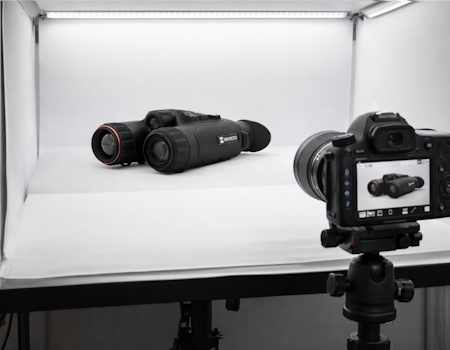
DRACO is a true 4-in-1 multispectral binocular platform combining thermal imaging, 4K digital day/night vision, a built-in laser rangefinder, and detachable IR illumination — designed to give fast detection, confident identification, and accurate ranging from a single handheld unit.
What makes DRACO different
DRACO is built around a simple field workflow: detect (thermal), identify (4K digital), and measure distance (LRF) — without swapping devices or breaking observation.
- Ergonomic ~600g-class body for comfortable handheld use, with a familiar binocular-style control wheel.
- Immersive two-eye viewing via a 0.49" Full HD OLED display and curved UI layout for a natural observation field.
- PIPS 3.0 AI image processing to enhance clarity and consistency in both thermal and digital channels.
- Detachable IR illuminator (850nm / 940nm options) to extend digital night viewing in very low light.
- Dual-band Wi-Fi + 64GB storage for streaming, sharing, and recording photos/videos.
- Flexible power: removable 18650 batteries, USB-C charging, power bank support, and single-battery operation.
Quick pick
D225 = most approachable • D335 = best all-round thermal step-up • D635 = premium thermal detail + wider scan
Best for
DRACO is designed to improve situational awareness across day, dusk and darkness — in open terrain, woodland, and poor visibility.
Ideal use cases:
Outdoor exploration • Hunting • Wildlife/animal observation • Security & surveillance • Night-time property checks
How to think about the three models
- D225: compact entry into multispectral; great for closer to mid-range thermal needs and strong 4K ID.
- D335: the thermal “workhorse” step-up; stronger thermal resolution and reach for mixed terrain.
- D635: premium thermal detail and wider thermal field of view; best for scanning and confident long-range observation.
Tip: Use thermal to find heat quickly, then switch to 4K digital to identify detail/behaviour, and confirm distance with LRF.
Model breakdown
All DRACO models share the same core concept and handling. The key differences are thermal sensor resolution, thermal lens configuration / field of view, and the overall balance of scan speed vs detail.
D225
D225 overview: The most approachable DRACO model — combining thermal detection, crisp 4K digital day/night viewing, LRF to 1000m, and detachable IR illumination in a compact, ergonomic chassis.
- Most approachable DRACO model for stepping into thermal + 4K digital + LRF.
- Strong 4K digital channel for identification in daylight and low light.
- Compact handling with binocular-style controls for easy use in the field.
- Full platform features: EIS, defog, PIPS 3.0, dual-band Wi-Fi, 64GB recording.
- Lower thermal resolution than D335/D635, so fine thermal detail is reduced at distance.
- Narrower thermal performance headroom for demanding long-range scanning compared to higher-tier sensors.
Recommended for: hunters and wildlife watchers who want an all-in-one device for detection + ID + ranging, with the most accessible thermal spec in the range. Great for mixed woodland/farmland, night property checks, and anyone prioritising compact versatility.
D335
D335 overview: The DRACO “workhorse” — a major step-up in thermal performance while keeping the same compact chassis and full feature set. Built for users who want stronger thermal reach and clarity for real-world mixed terrain.
- Big thermal upgrade over D225: higher resolution + ≤15mK sensitivity for clearer thermal layers.
- Excellent balance of scan capability and usable magnification for farmland/woodland/open hill work.
- Keeps the same 4K digital channel for identification and evidence capture.
- Full platform toolkit: PIPS 3.0, EIS, defog, menu memory, dual-band Wi-Fi, 64GB.
- Not as “fine detail” rich as a 640-class thermal sensor (D635) when pushing distance/identification.
- Thermal field of view is narrower than the D635’s wider scan window.
Recommended for: the majority of serious users — hunting, wildlife management, security patrols and night operations — where you want a notable thermal performance step-up while keeping the compact binocular form factor.
D635
D635 overview: The premium DRACO model — highest thermal resolution in the range and a wider thermal field of view, built for fast scanning and confident detail where clarity matters most.
- Highest thermal resolution in the DRACO line for richer detail and more confident observation.
- Wider thermal field of view makes scanning large areas faster and more comfortable.
- ≤15mK sensitivity + PIPS 3.0 helps maintain clarity in haze, fog and poor weather.
- Full multispectral toolset: 4K digital ID + LRF + IR illuminator + recording/streaming.
- Higher-spec thermal comes at a higher investment than D225/D335.
- Lower base thermal magnification prioritises scanning and situational awareness over a “zoomed-in” starting view.
Recommended for: users who prioritise thermal image quality and fast, wide-area scanning — open ground, coastal, hill, large farmland, professional observation and security work where detail and clarity are key.
Full specification comparison
This table highlights the practical differences that matter: thermal sensor & lens, field of view, magnification behaviour, detection range, and the shared platform features across the DRACO range.
Tip: On mobile, swipe left/right. The left column stays fixed for easy comparison.
| Specification | D225 | D335 | D635 |
|---|---|---|---|
| Positioning | Most approachable multispectral entry | Best all-round workhorse | Premium thermal detail + wider scan |
| Thermal sensor | 256×192 VOx • 12µm • ≤18mK | 384×288 VOx • 12µm • ≤15mK | 640×512 VOx • 12µm • ≤15mK |
| Thermal lens | 25mm f/0.9 (manual focus) | 35mm f/0.95 (manual focus) | 35mm f/1.0 |
| Thermal FOV @ 100m | 12.2m × 9.3m | 13.7m × 10.3m | 21.9m × 17.6m |
| Thermal base magnification | 4.3× | 3.8× | 2.5× |
| Thermal digital zoom | 1–8× | 1–8× | 1–8× |
| Thermal magnification range (stated) | 4.3× – 34.4× | 3.8× – 30.4× | 2.5× – ~20× |
| Thermal detection range (stated) | ≈1300m | ≈1800m | ≈1800m |
| Digital sensor | 1/1.8" CMOS • 4K 3840×2160 (day/night) | ||
| Digital lens | 55mm f/2.0 (manual focus stated on D225) | ||
| Digital FOV @ 100m | 14.0m × 8.8m | ||
| Digital magnification | 5.5× optical • 1–8× digital (to 44×) | ||
| Display | 0.49" OLED • 1920×1080 • binocular-style viewing | ||
| Image processing | PIPS 3.0 AI enhancement | ||
| Stability features | Electronic Image Stabilisation (EIS) • Defog mode • Menu memory | ||
| Thermal palettes | White Hot • Black Hot • Iron Red • Alarm • Green Hot • Sepia | ||
| Digital modes | Colour • Black & White • Green • Yellow • Auto | ||
| Laser rangefinder | Integrated LRF • up to 1000m • ±1m stated (Class 1 referenced) | ||
| IR illuminator | Detachable 850/940nm options (850nm referenced) | Detachable 850nm / 940nm | Detachable 850nm / 940nm |
| Storage | 64GB internal (photo/video recording) | ||
| Wi-Fi | Dual-band 2.4GHz + 5GHz (App streaming/transfer) | ||
| Power | Removable 18650 • dual battery (can run single) | 2× 18650 removable • can run single | Removable 18650 |
| Runtime (stated) | ≈9 hours | ≈8 hours | ≈8 hours |
| Dimensions | 195 × 130.6 × 61.7 mm | ||
| Weight | ~0.61 kg | ~0.62 kg | ~0.62 kg |
| Protection rating | IP67 | IP67 | IP67 |
| Fit adjustments | Interpupillary 60–74mm • foldable eyecups | Interpupillary 60–74mm • foldable eyecups | Interpupillary 60–74mm • diopter −5D to +5D |
Choosing the right DRACO
If you’re deciding between models, focus on two questions: (1) how much thermal detail do you need? and (2) do you prefer scanning wider or starting more “zoomed in”?
You want the most accessible route into a multispectral binocular without giving up the key benefits of the platform: 4K digital ID, LRF, detachable IR and recording/streaming. You’ll still get strong thermal detection, but with a smaller sensor than the step-up models.
You want the best balance of thermal performance and cost. The 384×288 sensor and ≤15mK sensitivity are a meaningful real-world upgrade, making this the most broadly suited option for hunters, wildlife managers and security users.
You want premium thermal detail and the widest thermal scan window for covering ground quickly. If you spend lots of time scanning open areas (hill, coastal, large farmland) and you value rich thermal information, the 640-class sensor is the standout.
One-line recommendations
D225: approachable multispectral all-rounder • D335: best all-round thermal upgrade • D635: premium thermal detail + wide scan