
WHAT IS THE BUNDLE BUILDER?
Add a rifle scope to your basket to begin your Bundle Build. Complete your shooting package with mounts and an accessory and enjoy up to 10% off your entire order.
How It Works
1. Add your chosen rifle scope to your basket and the Bundle Builder becomes available.
2. Add a set of mounting rings, save 5%
3. Add an accessory, save 5%
The discounts STACK:
Add just a set of mounting ring? 5% saving
Add just an accessory? 5% saving.
Add both a set of mounting rings and an accessory? 10% saving.
Add anything else to your basket on top of your bundle? 10% saving.
Build With Confidence
Not sure which scope you should get? Unsure about mounts or accessories? No problem.
Just click the green chat icon in the bottom corner to chat with our IRIS AI assistant and start building your bundle with expert guidance.
WHAT IS THE BUNDLE BUILDER?
Add a rifle scope to your basket to begin your Bundle Build. Complete your shooting package with mounts and an accessory and enjoy up to 10% off your entire order.
How It Works
1. Add your chosen rifle scope to your basket and the Bundle Builder becomes available.
2. Add a set of mounting rings, save 5%
3. Add an accessory, save 5%
The discounts STACK:
Add just a set of mounting ring? 5% saving
Add just an accessory? 5% saving.
Add both a set of mounting rings and an accessory? 10% saving.
Add anything else to your basket on top of your bundle? 10% saving.
Build With Confidence
Not sure which scope you should get? Unsure about mounts or accessories? No problem.
Just click the green chat icon in the bottom corner to chat with our IRIS AI assistant and start building your bundle with expert guidance.
Now that you’ve chosen your rifle scope, the next step is selecting the correct mounting rings. This is just as important as choosing the scope itself as the wrong rings simply won’t fit, and even the best scope won’t perform properly if mounted incorrectly.
There are three key things you must match correctly:
- Tube diameter
- Rail type
- Mount height
Get these right and your setup will be solid, aligned and reliable from day one.
1. Tube Diameter (Most Important)
Your mounting rings must match the diameter of your scope tube.
- 1 inch (25.4mm)
- 30mm
- 34mm
These are not interchangeable. Always check your scope specifications before choosing rings.
2. Rail Type (What Your Rifle Has)
You must match the mounting system on your rifle.
- 11mm Dovetail Rail – Most common on UK air rifles.
- Picatinny Rail – Wider, squared rail system often found on tactical-style rifles.
Dovetail and Picatinny mounts are completely different and are not interchangeable. Always check your rifle’s rail type before choosing.
3. Mount Height
Mount height determines how high your scope sits above the rifle.
- Low
- Medium
- High
The correct height depends on your objective lens size (40mm, 44mm, 50mm etc.), magazine clearance and personal preference. For most air rifle setups with 40–44mm objectives, medium mounts are usually ideal.
Two-piece mounts are the most common and work perfectly for most air rifles.
One-piece mounts offer additional rigidity and can be particularly useful on spring-powered rifles due to their double recoil. Many one-piece mounts also include a recoil stop pin for added security.
For spring rifles especially, a mount with a recoil stop is highly recommended.
Spring-powered air rifles produce both forward and rearward recoil. This can cause mounts to creep backwards over time.
If you are using a spring rifle, look for:
- A recoil stop pin
- A solid clamping system
- Strong build quality
PCP rifles are far less demanding on mounts.
What size rings do I need?
Match the ring size to your scope tube - 1 inch, 30mm and 34mm are most common.
How do I know if my rifle is dovetail or Picatinny?
Most traditional UK air rifles use 11mm dovetail rails. Tactical-style rifles may use Picatinny. Check your rifle specifications if unsure.
Do I need high mounts?
Only if you have a large objective lens or clearance issues. Medium mounts suit most air rifle scopes.
Can I use adapters?
Dovetail-to-Picatinny adapters exist, but using the correct mount for your rail is always preferable.
What happens if I choose the wrong rings?
They simply won’t fit properly. Tube diameter and rail type must match exactly.
If you’re unsure, our Iris AI can recommend the correct mounting rings for your rifle and scope combination, ensuring everything fits perfectly from the start.
Now that your rifle scope and mounting rings are sorted, it’s time to complete your setup with the right accessories.
Accessories aren’t just add-ons, they protect your investment, improve accuracy, make transport easier and ensure you can shoot consistently and safely.
The key is choosing what suits how and where you shoot.
Protecting your rifle is essential, especially when transporting it.
- Padded rifle bags or hard cases for safe storage
- Secure zips and reinforced stitching
- Correct internal length for your rifle
- Sling attachment points if needed
A quality bag protects your investment, while slings make carrying your rifle more comfortable during pest control or longer sessions outdoors.
Stability equals accuracy.
Bipods & Tripods
- Height adjustment range
- Weight and portability
- Attachment method (stud mount, Picatinny etc.)
- Whether you prioritise compactness or maximum stability
Tripods offer excellent stability for varied distances. Bipods are lighter and more compact.
Shooting Rests & Bags
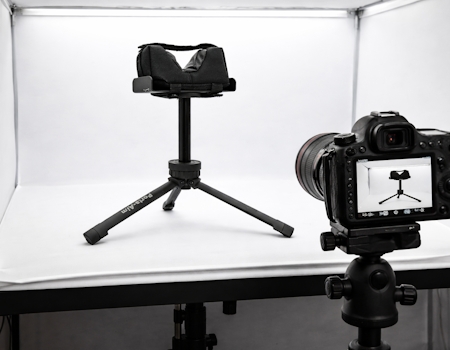
- Sand-filled or adjustable rests
- Front and rear bag combinations
- Stable base for consistent grouping
Ideal for bench shooting, zeroing and improving consistency.
If you’re using a PCP air rifle, you’ll need a charging solution.
Compressors
- Convenient for home use
- Ideal for frequent shooters
- Faster refill times
Pumps
- Budget-friendly option
- Physically demanding
- Best for occasional use
Choose based on how often you shoot and how convenient you want refilling to be.
Your pellet choice affects accuracy more than most people realise.
- .177 – Flatter trajectory, popular for target shooting
- .22 – Larger pellet, often preferred for pest control
Every rifle prefers different pellet brands, so testing a few types is recommended to find the most accurate option for your setup.
Targets help you practise and improve.
- Paper targets for precision and grouping
- Metal knockdown targets for reactive shooting
- Sticker targets for high visibility
If you’re zeroing your rifle, paper targets are essential.
Keeping your barrel clean helps maintain accuracy.
- Pull-through cleaning kits
- Cleaning pellets
- Barrel-safe solvents
Air rifles don’t require constant cleaning, but periodic maintenance improves consistency and performance.
A small accessory that can make a big difference.
Bubble levels attach to your scope and help prevent rifle cant (tilting). Even slight cant can shift your point of impact at longer air rifle distances.
Especially useful for target shooters and anyone stretching beyond 35–40 yards.
What accessories do I actually need to start?
A good rifle bag, quality pellets and safe charging equipment (for PCP rifles) are the essentials.
Do I need a bipod?
Not essential, but it improves stability, especially for pest control or zeroing.
Is a compressor better than a pump?
For regular PCP shooting, yes. Pumps are more affordable but require physical effort.
How important are pellets?
Extremely. Pellet choice can dramatically affect grouping and consistency.
Do I need cleaning tools straight away?
Not immediately, but they are worth having for periodic maintenance.
If you’re unsure, Iris AI can help recommend the right accessories to complete your setup with confidence.
F-Class is a Full-Bore target discipline using modern bolt action rifles where the shooter adopts the prone position and shoots out to a maximum of 1000 yards.
F-Class was started in Canada by George Farquharson as a way to keep Target Shooting as he got older. This is evident by the fact that Bipods and Rear Rests are permitted in F-Class as well as the use of Optics.
So what should you look for in an optic for F-Class?
Magnification
High magnifications are desirable in F-Class as they allow the shooter to see further away more easily. A typical magnification for an F-Class scope would be something like 5-50x as found on the Delta STRYKER.
Objective
Because of the high magnifications used in F-Class, larger objective lenses are preferred as they allow the image to stay as bright as possible at those higher magnifications (most Scopes used for F-Class have objective lenses no smaller than 56mm). This being said a Scope that has high-quality glass with high light transmission may be able to get away with having a smaller objective lens.
Reticle
In short, the reticle you use for F-Class is entirely down to personal preference. You might want a busy “Christmas Tree” reticle with lots of markings showing exactly how much MOA you are holding over, or you might want a simple Mil-Dot that provides you with an uncluttered view of the target.
FFP or SFP?
Again this is a personal choice. FFP (First Focal Plane) reticles have the advantage that the reticle scales with the image meaning that its markings stay true throughout the magnification range. SFP (Second Focal Plane) reticles have the advantage that they stay the same size regardless of magnification meaning that the reticle won't block your field of view.
Adjustment/Turrets
You will want a Scope with a considerable amount of adjustment as this will give you plenty of room to dial in for your desired point of impact. If your Scope does not have enough adjustment built-in you can make up for this by mounting your Scope with an MOA rail or Mounts.
Most shooters in F-Class go for Scopes with exposed target-style turrets as this makes it easy for making quick adjustments. Another thing to consider is that makings on the turrets are clear and precise so that you know exactly how much adjustment you are making.
MOA/MIL/MRAD
Mostly the choice between MOA and Mils/MRAD is down to personal preference. The most important thing to consider is the amount of adjustment per ‘click’. Common choices are ⅛ MOA or 0.5 MRAD as these allow for very fine adjustments to be made.
Weight
F-Class has weight restrictions on the Rifle you use and includes all attachments such as Scopes. For this reason, it is important to get a Scope that balances all of the above. Most manufacturers do try to make Scopes as light as possible but in reality, they can still be fairly heavy. It is important to make sure the Scope and Rifle combination you pick does not put you over the weight restriction of your particular event.
Finance is provided by Omni Capital Retail Finance Ltd which is a credit provider/lender. Optics Warehouse does not receive payment for introducing customers to Omni Capital Retail Finance. Omni Capital Retail Finance Ltd finance options are subject to individual status; terms and conditions apply. Omni Capital Retail Finance Ltd is registered in England and Wales with company number 7232938. Registered address: 10 Norwich Street, London, EC4A 1BD.
Authorised and regulated by the Financial Conduct Authority, Firm Reference Number: 620615.